
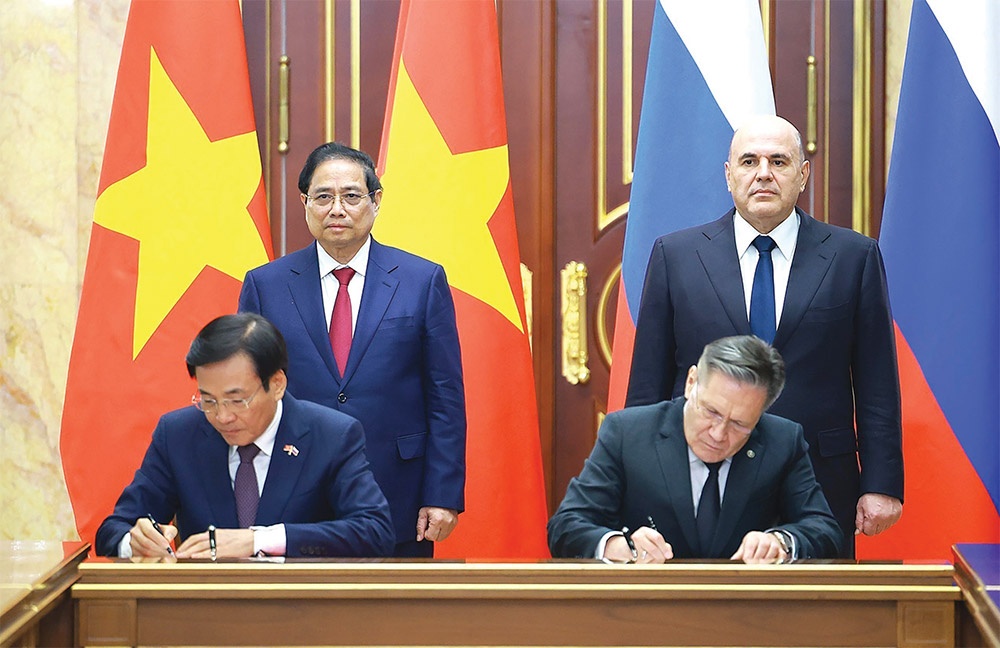
Nuclear plans develop as crucial cornerstone, photo VNA
Last week in Moscow, Vietnam and Russia signed an intergovernmental agreement on cooperation to build a nuclear power plant in Vietnam. The deal marks a significant step forward in bilateral collaboration on the peaceful use of nuclear energy and is widely expected to become a new symbol of the enduring Vietnam-Russia friendship.
Alongside the signing, the two sides concluded a series of technical negotiations paving the way for the construction of Ninh Thuan 1 nuclear power plant. According to Rosatom, Russia’s state-owned nuclear energy corporation, the project is planned to include two Russian-designed generating units with a combined installed capacity of 2,400MW. The Leningrad II nuclear power plant has been selected as the reference model.
“For us, this is not merely a contract to build two nuclear power units. We see it as the foundation for a long-term industrial partnership that will strengthen Vietnam’s energy independence and open up new opportunities for economic growth,” said Alexey Likhachev, director general of Rosatom.
Under Vietnam’s revised Power Development Plan VIII, the country aims to bring Ninh Thuan 1 and 2 into operation between 2030 and 2035, with a combined capacity of 4,000-6,400MW. By 2050, an additional 8,000MW of nuclear capacity will be required to provide stable baseload power, with the potential for further expansion depending on demand.
On the ground, both projects are entering a critical phase focused on resolving land clearance and legal obstructions. These nationally significant developments are seen as strategic pillars for ensuring Vietnam’s long-term energy security, in line with the country’s policy direction.
In the middle of March, Trinh Minh Hoang, Vice Chairman of Khanh Hoa People’s Committee, chaired a meeting to review implementation progress. At the site of Ninh Thuan 1 in Phuoc Dinh commune, compensation plans have been announced in three phases, covering 250 affected cases. Authorities are currently finalising land pricing as the basis for payments, with approval expected imminently.
For the resettlement area serving the project, compensation plans have been publicly disclosed for approximately 55ha, with land valuation procedures nearing completion. Direct compensation payments to residents are scheduled to begin in April to facilitate early stabilisation of livelihoods.
At the Ninh Thuan 2 site, land acquisition affects over 530 households. The vast majority have been presented with compensation plans, including 120 households that have already received advance payments totalling more than VND109 billion ($4.3 million). The project’s resettlement area covers 31.8ha, with estimated compensation costs of VND255 billion ($10 million), and is currently undergoing final administrative procedures.
Notably, all land measurement, inventory and origin verification has been completed. Total disbursement for compensation and resettlement support has reached VND 3.236 trillion ($129 million), fulfilling the entire 2025 funding plan.
However, certain policy-related constraints remain, preventing large-scale, synchronised site handover.
To address these issues, the provincial government has proposed that the National Assembly Standing Committee issue a dedicated resolution on compensation and resettlement mechanisms. On the investment front, the government in March issued appraisal of adjustments to the Ninh Thuan 1 facility. The Ministry of Finance will lead the appraisal council to finalise documentation for submission in April.
Vice Chairman Hoang called for stronger inter-agency coordination, rigorous review of eligible beneficiaries, and intensified public communication efforts. “The overarching goal is to ensure all conditions are met for site handover to the investor, with a view to bringing the plants into operation between 2030 and 2035 as planned,” he said.
Hoang Sy Than from the Vietnam Atomic Energy Institute noted that restarting the Ninh Thuan nuclear power programme is a key driver of Vietnam’s transition towards a greener economy. It is expected to elevate the country’s scientific, technological, and industrial capabilities.
The development of nuclear power infrastructure typically unfolds in three phases over 10-15 years, from the government’s initial decision to adopt nuclear energy to the commercial operation of the first plant. According to the International Atomic Energy Agency (IAEA), Vietnam is currently in Phase 2 of this process.
To enhance effectiveness, Than emphasised the importance of international cooperation in technology transfer and specialised human resource training, particularly with experienced partners such as Russia.
“Vietnam must also strengthen the capacity and efficiency of its state management system, including establishing an independent, competent and professional nuclear regulatory authority to ensure effective oversight and enforcement,” he said.
Meanwhile, Nguyen Tai Anh, deputy general director of Vietnam Electricity (EVN), stressed that nuclear power projects are of both national and international significance. “The Ninh Thuan Management Unit should maintain close coordination with the IAEA and partners such as Rosatom, while actively participating in negotiations, training programmes and professional exchanges in line with EVN directives.”
