
Context
Your head sport coach walks in your door and tells you that they only want to train in the weightroom this offseason. No speed, conditioning, or change of direction work required. What do you do to sway the sport coach in this situation? Believe it or not this exact topic has co
me up multiple times in the last year when networking with high school strength and conditioning coaches. When this happens, it falls on the strength and conditioning coach to explain why such a strategy is incomplete—and why off-season development must blend both strength training and general skill work to create a comprehensive preparation program. Communication is of utmost importance and comprehension of training principles will allow the S&C to make the complex simple. This example will serve as a fictional account that provides the strength and conditioning coach with references and reasoning why only lifting would be a bad idea for a field based sport.
Why the Weightroom-Only Approach Falls Short
The weight room is invaluable in helping athletes reach their full potential and stay healthy. The benefits of weight training include increased cross-sectional area of muscle fibers, force output, and tissue and tendon resilience (Hoffman, 2014). It is very easy to quantify increases in the weight room. The only way to mark progress before the emergence of sport science tools such as global positioning devices (GPS) and force plates, was by showing how much an athlete’s one-rep max has improved. Sport science tools now provide insight into neuromuscular adaptations and in-game evidence of improvement from training through biomechanical output that has occurred through the training prescribed. Sport science tools have also clarified and defined aspects of sports that were previously unknown, giving sports coaches data on workloads and actual game demands. The new information has changed how strength and conditioning coaches approach the planning process, illuminating true athletic indicators of successful performance.
The weight room alone cannot prepare an athlete for the competitive season of play and is a cog in the metaphorical offseason machine. Incorporating all facets of preparation will lead the strength and conditioning coach towards applying and enhancing speed and agility in the offseason training block. Specificity is a necessary principle that cannot be avoided in the training process. Proper navigation of the offseason continuum will start with general training methods and traverse towards specific training prior to the start of the season. Weightlifting is a very general training component when weighing the specificity level of the training component for track athletes and field-based athletes. In the following sections, the argument for the specificity of training for speed, change of direction (COD), and agility will be made for the hypothetical scenario provided, where the coach only wants to lift to enhance sports performance while preparing field-based athletes.
The weight room alone cannot prepare an athlete for the competitive season… Incorporating all facets of preparation will lead the strength and conditioning coach towards applying and enhancing speed and agility, says @CoachJoeyG
Share on X

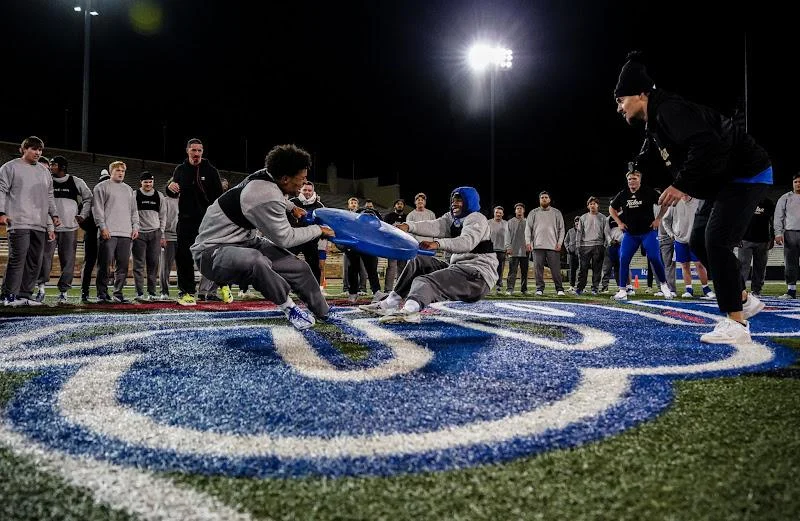
Image: University of Tulsa athletes performing a one on one tug of war that combines strength in a variety of angles and positions that can’t be trained in the weight room alone.
Specificity and Speed
Effective training prepares the athlete for the demands of the tasks being asked of them. The demands of track are extremely straight forward as the event dictates the physiological output. Field sports require deeper analysis as they are multifactorial in terms of key performance indicators. The principle of specificity abides by the general adaptation syndrome (GAS) model that implies a targeted stress will cause a targeted adaptation, provided the proper restoration phase is provided (Selye, 1946). The closer an activity in training is to the competitive event, the higher the level of specificity and transfer to the event (Verkhoshansky et al., 2009). This does not mean that general means of training like weightlifting should be avoided, but strength and conditioning coaches must understand that transfer of training is higher in some modalities and has global effects on the organism. Weightlifting aids in the enhancement of force production and rate of force production but is limited in kinetic specificity and kinematic specificity. Sprinting increases rate of force (RFD) capabilities, vertical stiffness through increased output of the stretch shortening cycle (SSC), and inter/intra limb coordination (Hoffman, 2014).
To improve speed, athletes must sprint. The determinants of sprinting, according to Clark (2014), are determined by horizontal force application, limb repositioning velocity, and stiffness qualities that are highly movement-specific. These components cannot be replicated in the weight room, as they are either too fast or lack vector-specific force application. The inhibition of muscles at high rates is a critical performance determinant in sprinting, as elite sprinting mechanics depend on neuromuscular timing and limb stiffness patterns specific to sprinting (Clark et al., 2014). Athletes experience upwards of four times their body weight in force on a single limb, under 100ms while sprinting (Clark, 2022). No exercise in the weight room can replicate that level of force output, inter/intra coordination, and speed of movement. Morin (2015) supports Clark’s emphasis on training transfer, showing that general strength work must complement, not replace, sprint-specific horizontal force development. Clark (2014) implores, through his biomechanical analyses, that even strong athletes fail to convert weight-room force to field acceleration unless they train force orientation and application timing under sprinting conditions. Sprinting is a skill that takes intent and repetition to enhance. Having vector-specific training and speed of movement are vital pieces to the coach’s ability to program workouts that drive speed. Though underpinning attributes of successful sprinting can be aided through weightroom interventions, sprint performance will be determined by practicing the act of sprinting.
Athletes experience upwards of four times their body weight in force on a single limb, under 100ms while sprinting. No exercise can replicate that level of force output, inter/intra coordination, and speed of movement, says @CoachJoeyG
Share on X

Image: University of Tulsa athletes performing timed sprints using a Brower timing system
COD and Agility
Field sports involve rapid decelerations, accelerations, and reactions to ball movement or opposing teams’ tactics (Young, 2022). Linear speed is only as good as the ability to change direction in field sports. Change-of-direction training is a preplanned acceleration into a deceleration, followed by an acceleration into a new direction (Sun et al., 2025). Athletes experience upwards of 6x body weight in forces in the predominant eccentric event of high-speed decelerations seen in COD (Harper et al., 2022). Similar to the above-stated argument, this cannot be replicated in the weight room, as this event is vector-specific and requires rapid inhibition of the muscles involved, as the duration of the penultimate steps is under 50ms. Harper (2022) states that increased deceleration capabilities drastically increase the athlete’s entry velocity and decrease the total time of the COD movement. Greater braking forces during the penultimate step help prepare the body for sharper directional changes or stops, thereby alleviating potentially high-risk knee joint loads, such as those that can lead to ACL injuries (Harper et al., 2022). COD is a skill that must be rehearsed and repped to improve biomechanical efficiency. The hierarchy of specificity for COD is above both weightlifting and sprinting when it comes to transfer of training for field sports.
Linear speed is only as good as the ability to change direction in field sports, says @CoachJoeyG
Share on X
Agility is the same as COD, but with the movement being initiated by a reactive component. These reactive stimuli can be the ball, opposing players, or the athlete’s teammates. The reactionary components of agility can be classified into four distinct categories. Observe, orient, decide, and act (OODA) were identified by Boyd (1987) as the factors that determine victory in dogfights in war, as pilots had to make life-or-death decisions based on enemy activity. Pilots who could navigate this OODA loop had the highest success rate in combat. This theory has emerged in sport to describe superior agility performances in play. Observing the environment requires pattern recognition, which is why athletes watch game film and run scout teams before executing a specific tactic. The orientation process draws on the athlete’s previous experiences in similar situations to inform the next component: deciding on the action. This orient process is where COD techniques and training appear. Proper biomechanical positioning seen in the open field of play has been rehearsed several hundred times prior in training with an emphasis on proper positioning and force application. Once the decision is made, the action is thoughtless and automated (Boyd, 1987). Agility plays a significant role in the mitigation of injuries, as Harper (2022) attributes a high percentage of ACL injuries to the inability to orient a player’s body into a mechanical safe position based on a reactive component in play. Having the ability to react and COD at a faster rate can be a byproduct of a properly planned offseason which a weightroom cannot provide alone.

Image: The OODA loop (observe, orient, decide, act) describes the process of an athlete observing the environment around them and how they react to it (Image credits: OODA Loop diagram courtesy of Visual Paradigm Online, from What is OODA Loop?, available at: https://online.visual-paradigm.com/knowledge/decision-analysis/what-is-ooda-loop/)
Conclusion
The weight room benefits athletes in many ways but relying solely on that one training modality will limit transfer to the sport and raise the potential of injury due to the lack of exposure to playing elements not being addressed. Athletes must sprint to become faster. Providing training sessions that incorporate accelerations, resisted sprints, and top-speed work will increase vector-specific force output, biomechanical movement efficiency, and muscle stiffness through enhanced SSC abilities (Clark et al., 2014). Track events are very specific and pronounced in terms of the key performance indicators. Not training these KPI for the track athlete is borderline reckless and irresponsible of the preparation coach.

Image: University of Tulsa athletes training and wearing GPS units to track performance and workloads.
Field sport athletes require exposure to sprinting but training needs to go much deeper as the games have a high volume of COD. Change of direction training sessions require pre-planned changes in direction and act as the regression to agility, which is COD with a reactionary element (Dos’Santos et al., 2017). Training the OODA loop through agility sessions will enable the athlete to improve reactive abilities and biomechanical positioning of COD in play. Training must provide transfer to sport, or it is inefficient in application which will diminish performance and raise injury potential. Strength and conditioning coaches’ responsibility is to check all boxes of physiological performance attributes prior to the start of the competitive season. The weightroom is a major piece, but a piece and not the whole.
S&C coaches’ responsibility is to check all boxes of physiological performance attributes prior to the start of the competitive season. The weightroom is a major piece, but a piece and not the whole, says @CoachJoeyG
Share on X
References
Bondarchuk, A. P. (2010). Transfer of training in sports (Vol. 2). Ultimate Athlete Concepts.
Boyd, J. R. (1987). The Essence of Winning and Losing [Lecture notes]. United States Air Force.
Clark, K. P. (2022). Determinants of top speed sprinting: minimum requirements for maximum velocity. Applied Sciences, 12(16), 8289. https://doi.org/10.3390/app12168289
Clark, K. P., & Weyand, P. G. (2014). Are running speeds maximized with simple‐spring stance mechanics? Journal of Applied Physiology, 117(6), 604–615. https://doi.org/10.1152/japplphysiol.00174.2014
Dos’Santos, T., Thomas, C., Jones, P., & Comfort, P. (2017). Mechanical determinants of faster change of direction speed performance in male athletes. Journal of Strength and Conditioning Research, 31(3), 696-705. https://doi.org/10.1519/JSC.0000000000001535
Harper, D. J., McBurnie, A. J., Dos’Santos, T., Eriksrud, O., Evans, M., Cohen, D. D., Rhodes, D., Carling, C., & Kiely, J. (2022). Biomechanical and neuromuscular performance requirements of horizontal deceleration ability: A review with implications for random, intermittent, multi-directional sports. Sports Medicine, 52, 2321-2354 https://doi.org/10.1007/s40279-022-01693-0
Hoffman, J. (2014). Physiological aspects of sport training and performance (2nd ed.). Human Kinetics.
Morin, J.-B., Slawinski, J., Dorel, S., Saez de Villarreal, E., Couturier, A., Samozino, P., & Brughelli, M. (2015). Acceleration capability in elite sprinters and ground impulse: Push more, brake less? Journal of Biomechanics, 48(12), 3149-3154 https://doi.org/10.1016/j.jbiomech.2015.07.009
Selye H. (1946). The general adaptation syndrome and the diseases of adaptation. The Journal of clinical endocrinology and metabolism, 6, 117–230. https://doi.org/10.1210/jcem-6-2-117
Sun, M., Soh, K. G., Cao, S., Yaacob, A. B., Ma, S., & Ding, C. (2025). Effects of speed, agility, and quickness training on athletic performance: a systematic review and meta-analysis. BMC sports science, medicine & rehabilitation, 17(1), 66. https://doi.org/10.1186/s13102-025-01101-w
Verkhoshansky, Y. V., & Siff, M. C. (2009). Supertraining (6th expanded ed.). Verkhoshansky Publications.
Young, W., Rayner, R., & Talpey, S. (2021). It’s time to change direction on agility research: A call to action. Sports Medicine – Open, 7(1), 12. https://doi.org/10.1186/s40798-021-00304-y
The post What Do You Do When Your Sports Coach Tries to Suggest Training Advice? appeared first on SimpliFaster.
