
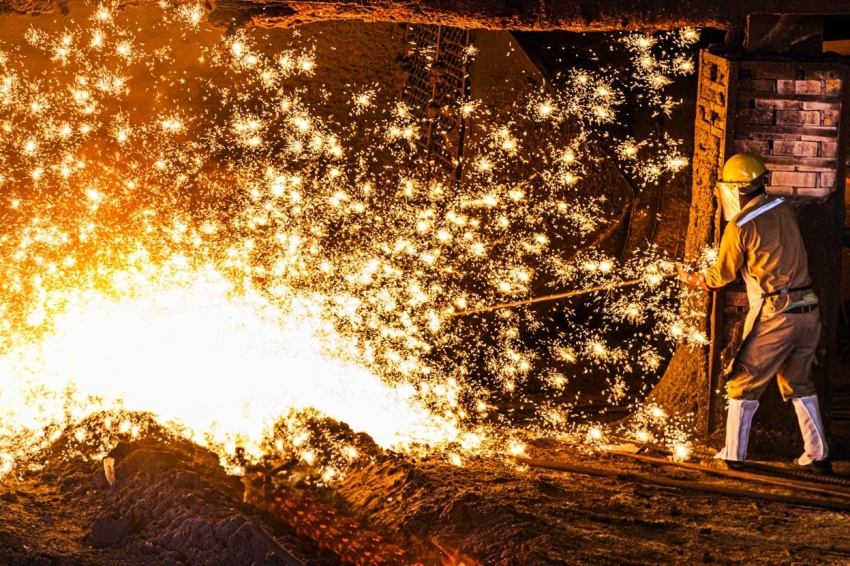
Illustrative photo courtesy of Hoa Phat Group
Speaking at the Ministry of Industry and Trade’s conference on encouraging double-digit export growth on June 25, Dinh Quoc Thai, vice chairman and secretary general of the Vietnam Steel Association (VSA), said the global steel industry was showing signs of recovery.
According to the World Steel Association, global steel production posted positive growth in the first four months of 2026, reflecting stronger manufacturing activity and rising demand from steel-consuming industries.
Vietnam’s steel industry has also experienced a broad-based recovery across the entire value chain, from raw material production to finished products.
Crude steel output reached 2.6 million tonnes in May, up 27.2 per cent on-year, marking the highest growth rate among the world’s top 10 steel-producing countries. Output totalled 12.6 million tonnes in the first five months of 2026, up 26.8 per cent compared to the same period last year.
Thai estimated that steel production would reach around 14.8 million tonnes in the first half of 2026, up 21.2 per cent on-year, while steel consumption is expected to increase 13.1 per cent to 17.9 million tonnes.
However, steel exports are projected to decline by 4.8 per cent to around 1.79 million tonnes during the same period.
Despite the weaker export performance, the VSA remains optimistic about the industry’s overall outlook. Crude steel output is forecast to reach approximately 27 million tonnes in 2026, up 10 per cent from the previous year. Finished steel production is expected to total around 33 million tonnes, while domestic consumption is projected to reach 28 million tonnes.
Steel exports are forecast at around 6 million tonnes for the full year, while imports are expected to decline compared to 2025.
“The combination of higher exports and lower imports is a positive signal,” Thai said. “This reflects effective domestic market management, trade policy measures introduced by the Ministry of Industry and Trade, and the improving ability of Vietnamese steel producers to meet market demand.”
Nevertheless, Thai warned that the industry would continue facing significant headwinds in the second half of the year.
Global steel overcapacity is driving an increasing number of trade protection measures in key export markets. The United States, for example, has imposed tariffs of up to 50 per cent on certain steel products under Section 232 of the Trade Expansion Act, while more trade remedy investigations targeting Vietnamese steel products have also been initiated.
At the same time, tightening greenhouse gas emission requirements and the gradual introduction of carbon border adjustment mechanisms across major markets are creating additional challenges for steel exporters.
Although Vietnam has improved domestic supplies of some raw materials, the country still relies on imports of iron ore, scrap steel and several other key inputs, Thai said.
Despite ongoing challenges arising from the global economic slowdown, prolonged geopolitical tensions and market volatility, the VSA believes Vietnam’s economy remains relatively resilient compared to other ASEAN countries, providing a solid foundation for the steel industry’s continued recovery.
To support sustainable development, the VSA identified two strategic priorities: protecting the domestic market from surging imports of low-priced steel and accelerating green and digital transformation to meet evolving market requirements.
The association also called for long-term policies to encourage domestic investment and production, alongside early implementation of regulations requiring imported steel products to comply with Vietnamese quality standards before entering the domestic market.
The VSA has also proposed strengthening trade remedy investigations to address unfair competition, while providing greater support for steel producers facing overseas trade defence cases to help maintain and expand export markets.
The association recommended accelerating the development of national technical standards for steel products and enhancing market monitoring and forecasting to enable businesses to respond more effectively to changing market conditions.
