
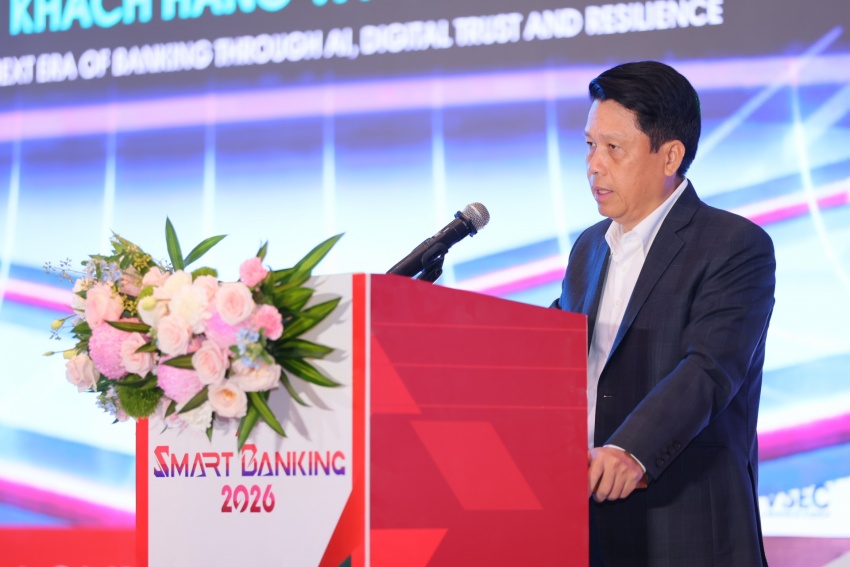
Speaking at the Smart Banking 2026 Conference and Exhibition in Hanoi on October 22, Pham Tien Dung, Deputy Governor of the State Bank of Vietnam (SBV), said the banking system was currently processing around 100 million payment transactions a day, with a total value of approximately $48 billion. This is an enormous figure when compared with Vietnam’s GDP, which currently stands at around $500 billion.
“Whereas the previous phase of digital transformation in the banking sector focused primarily on digitising processes and moving services into the digital environment, the next phase must focus on leveraging data, applying artificial intelligence and developing intelligent operating models,” said Dung. “Competitive advantage no longer lies in which bank adopts more technology, but in the ability to turn data into value and technology into productivity and operational efficiency, while strengthening customer trust.”
Dung highlighted several key messages.
The first is that AI must deliver tangible value rather than merely create a technological impression. Technology only has real meaning when it helps customers receive better service, enables banks to operate more efficiently and allows risks to be identified earlier.
“AI must therefore be embedded in an organisation’s overall development strategy and integrated with its data, business processes, human resources and governance model. AI is not solely the responsibility of the technology department; it is also a strategic issue involving business models and the governance responsibilities of each bank,” Dung said. “Alongside the national AI development strategy, the SBV has issued a circular stipulating safety and risk management requirements for AI applications in the banking sector. I urge credit institutions to study it carefully and implement it rigorously.”
Pham Tien Dung, Deputy Governor of the State Bank of Vietnam. Photo: IEC Group
The second message, Dung stressed, is that the more digitalised banking becomes, the more important trust is as an asset of the banking system.
“The SBV requires credit institutions to provide features that enable customers to proactively configure account protection measures, including a mechanism to set a waiting period for first-time fund transfers, which can be as long as 24 hours before the recipient receives the money,” he said. “At some banks, more than 95 per cent of transactions are now conducted through digital channels. Given the enormous scale and value of these transactions, customer trust is the most important asset the banking system must continue to preserve and strengthen.”
The third message Dung put forward is that resilience must become a core capability of every bank.
“Cybersecurity risks are no longer an issue solely for information technology departments; they directly affect business operations, reputation, customer trust and the stability of the banking system,” he added. “AI is opening up a new phase of development for the banking sector, but to turn technological potential into tangible value, banks must address data challenges, customer trust and system security simultaneously.”
Le Anh Dung, deputy director general of the SBV’s Payment Department, said the banking sector was moving from digitising individual services to digitalising the entire customer journey. The next phase will involve integrating banking services into intelligent digital ecosystems, with AI acting as an orchestrator built on clean data, reliable identity verification, and trusted payment and credit infrastructure.
“This process requires the banking sector to meet three objectives simultaneously: innovate to create value, build trust to encourage the use of services, and maintain resilience to protect the value created. Innovation must go hand in hand with institutional improvements, infrastructure development and better data; trust must be reinforced through identification, authentication, early warnings and improved financial literacy among users; and resilience depends on ensuring business continuity, security and safety, as well as the responsible deployment of AI,” said Anh Dung.
“Progress in digital payments and data is laying the groundwork for this transition. According to figures presented at the plenary session, mobile-channel payments grew strongly year on year in the first eight months. Payment infrastructure can process up to 40 million transactions a day, while the national credit information database now contains information on more than 57 million customers,” he added.
However, infrastructure and data can only deliver their full value when customers trust the services and use them. The SBV has implemented various measures to clean up data, strengthen biometric authentication and develop its SIMO early-warning system. According to Dung, the system has helped approximately two million customer instances suspend or cancel transactions after receiving warnings, involving a total value of $3.04 billion.
Overview of the Smart Banking 2026 conference. Photo: IEC Group
From the perspective of a commercial bank, Nguyen Hung, CEO of TPBank, emphasised that AI must be applied in practical ways that benefit customers or improve operational efficiency, rather than serving merely as a public relations or promotional tool.
“Looking back at the banking sector’s development, digital transformation has helped credit institutions reduce their reliance on paperwork, digitise processes and expand their ability to serve customers around the clock, 24/7. For TPBank, a digital platform is essential to scaling up operations and strengthening competitiveness. AI is expanding these capabilities further, from customer support and protecting the flow of funds to knowledge management, document processing and resource optimisation,” Hung said.
Harmon Wang, CEO of StreamCube Technology, stressed that financial fraud is becoming increasingly organised, globalised and sophisticated.
“Fraudsters can divide their operations into multiple stages, from approaching victims and carrying out scams to receiving, transferring and dissipating the proceeds. Therefore, examining individual transactions in isolation may not be sufficient to identify the entire fraud network,” Wang said.
“Anti-fraud efforts need to be organised as an ecosystem, with coordination among banks, telecommunications operators, police authorities, technology companies and other relevant organisations. Information on suspicious accounts, fraudulent websites, phone numbers and unusual activity patterns needs to be shared and analysed to enable timely warnings and countermeasures.”
Senior Lieutenant Colonel Trieu Manh Tung, deputy director of A05 under the Ministry of Public Security, warned that the threat of attacks on the information systems of financial institutions and banks was becoming increasingly real. According to Tung, cyberattacks are becoming more professional, tightly organised and transnational in nature.
Drawing on experience in handling cases, Tung said cybersecurity could not be the sole responsibility of specialised teams.
“Banks need to establish procedures for monitoring unusual transactions with the involvement of relevant departments, while preparing incident response plans and strengthening coordination to trace and block the flow of funds. Investment in cybersecurity should also be commensurate with investment in digital infrastructure development,” Tung said. “These warnings show that customer protection must extend beyond transaction authentication to become an end-to-end risk management capability.”
Insurtech reshapes Vietnam’s insurance sector
Insurtech is emerging as a key pillar of Vietnam’s digital insurance sector as demand for digital financial services continues to accelerate.
Vietnam pushes digital finance into tangible gains
On September 24 in Hanoi, the Ministry of Finance, together with other agencies, organised Vietnam Digital Finance 2026 under the theme “Powering an intelligent, secure, connected, and sustainable digital financial ecosystem.”
