
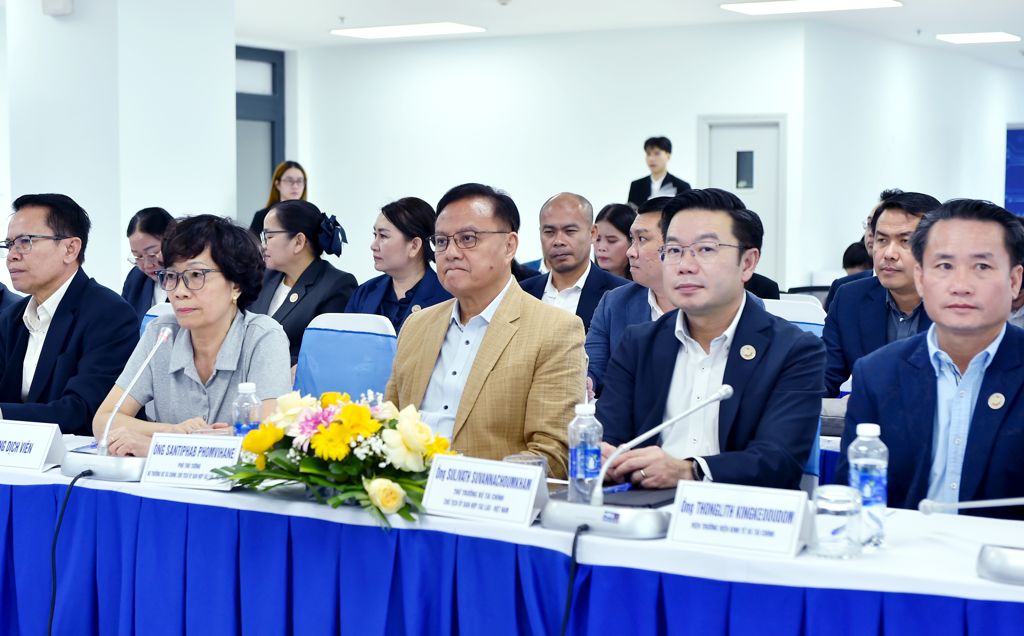
The delegations were led by Vietnamese Deputy Minister of Finance Tran Quoc Phuong and Lao Deputy Prime Minister and Minister of Finance Santiphat Phomviharn. The visit took place as part of the Mid-term Conference of the Vietnam-Laos Cooperation Committee for 2026 and the 19th meeting of the Steering Committee for the Cooperation Programme between the two finance ministries.
Drawing on Danang’s experience, the two sides discussed avenues for cooperation in technology development, human resources and business connectivity.
As part of the programme, the Vietnam-Laos Cooperation Committee delegation visited Software Park No. 2 in Danang to learn about the city’s digital transformation and digital government development, as well as its development plans for semiconductors and AI.
Lao DPM and Minister of Finance and Chairman of the Laos-Vietnam Cooperation Committee Santiphat Phomviharn. Photo: Chau An (MoF)
Speaking at the meeting, Lao DPM and Minister of Finance and Chairman of the Laos-Vietnam Cooperation Committee Santiphat Phomviharn thanked the Vietnamese Ministry of Finance (MoF) and Danang authorities for facilitating the delegation’s discussions, visit and exchange of experience on the city’s digital transformation.
He described Danang as a developed city with strengths extending beyond technology into a range of other areas. “Danang is not unfamiliar to me, but over the years I have witnessed the city’s remarkable development,” Phomviharn said.
The Lao DPM showed particular interest in the practical steps involved in building Danang’s technology ecosystem. He asked about the development of the city’s semiconductor and AI centre, from the initial conceptual stage to its current form.
He also sought information on how research outcomes and technology products developed by the centre are put into practical use and whether they meet market demand.
These questions reflected an interest in the way the technology ecosystem is organised and operated and how it creates practical value, alongside an understanding of its infrastructure and development model.
Responding to the Lao DPM’s questions, Truong Thanh Binh, director of the Danang Centre for Digital Transformation and Strategic Technology, said the city began developing its digital government in 2006, with the centre established in 2008.
The journey from the initial concept to the centre’s current model has therefore been a long-term process, with successive stages building on the foundations established earlier, rather than an initiative developed within a short period.
Danang also benefited from starting its digital transformation relatively early, allowing the city to build on capabilities accumulated over many years. Responsibilities among municipal agencies have been clearly defined, while the centre has shared its experience with other localities.
One of the key principles underpinning Danang’s digital transformation is “one platform, multiple partners.” Partners involved in implementation can build on the platform across different generations, based on an architectural framework established at an early stage.
He said that this approach helps minimise duplication, ensure continuity across the system and enable multiple partners to contribute to its development. In terms of infrastructure, units operating under the centre manage the infrastructure and assets supporting the city’s public administration. They also serve as a focal point for coordination and workforce training to support system operations.
MoF Deputy Minister Tran Quoc Phuong (middle) and Vice Chairman of Danang People’s Committee Tran Nam Hung (left). Photo: Chau An (MoF)
Speaking at the meeting, Vice Chairman of Danang People’s Committee Tran Nam Hung highlighted the close cooperation between Danang and Lao localities. Every year, the city organises a range of cooperation and exchange programmes with Lao localities, alongside specific initiatives to support each other’s socioeconomic development.
Danang places particular importance on and is encouraging cooperation with Lao localities in areas of mutual interest. Digital transformation, the semiconductor industry and AI are among the sectors receiving particular attention.
He expressed confidence that the visit would open up new opportunities for cooperation between Danang and Laos, contributing to strengthening the friendship, special solidarity and comprehensive cooperation between the two countries.
The city’s cooperation agenda extends beyond the exchange of experience to include workforce training, business connectivity, investment, technology transfer and the commercialisation of research products.
Danang aims to boost training programmes for semiconductor and AI engineers based on international standards, while strengthening exchanges among lecturers, experts and students from universities, research institutes and businesses on both sides.
The city also plans to encourage Lao businesses to invest in semiconductors and AI, develop deep-tech incubation programmes, connect investment funds, support technology transfer and facilitate the commercialisation of research outcomes.
Under its targets, Danang aims to attract 10-15 Lao businesses with total investment capital of approximately $300-500 million by 2030. The city also plans to organise business-matching programmes, thematic seminars and investment promotion activities involving businesses, research institutes and universities from both countries.
The delegation visiting FPT R&D Centre on high technologies and semiconductor. Photo: Chau An (MoF)
The Danang meeting took place as part of the Mid-term Conference of the Vietnam-Laos Cooperation Committee for 2026 and the 19th meeting of the Steering Committee for the Cooperation Programme between the Vietnamese and Lao MoFs, hosted by Vietnam.
As Vietnam’s focal agency for the cooperation programme and a bridge connecting central and local authorities with Lao partners, the MoF is well positioned to link government-level cooperation priorities with practical models, initiatives and needs at the local level.
The participation of Vice Chairman of the Vietnam-Laos Cooperation Committee and Deputy Minister Phuong, together with the delegation, helped bring bilateral cooperation closer to emerging areas of development, including digital technology, semiconductors, AI and high-quality human resources.
It also broadens the scope of cooperation from traditional sectors towards high-value-added technology industries, while creating additional channels for businesses from the two countries to identify specific cooperation opportunities.
For Laos, Danang’s experience offers lessons extending beyond a digital transformation model to include a long-term approach to building a technology ecosystem, organising resources, connecting multiple partners and directing research outputs towards the market.
For Danang, the Lao delegation’s direct interest in these areas creates opportunities to incorporate the city’s strengths in digital transformation, semiconductors, AI and workforce training into concrete international cooperation programmes.
Vietnam, Laos increase key transport infrastructure connectivity
Vietnam and Laos are working to boost key strategic infrastructure projects to increase connectivity between the two countries.
Vietnam channels $714 million into overseas projects
Vietnam’s outward investment capital reached nearly $714 million in the first four months of 2026, double the same period last year.
Vietnam and Laos step up cooperation in finance, infrastructure and energy
The mid-term conference of the Vietnam-Laos Cooperation Committee for 2026 and the 19th meeting of the Steering Committee for the Cooperation Programme between the Vietnamese and Lao Ministries of Finance were held in Danang on August 27.
