
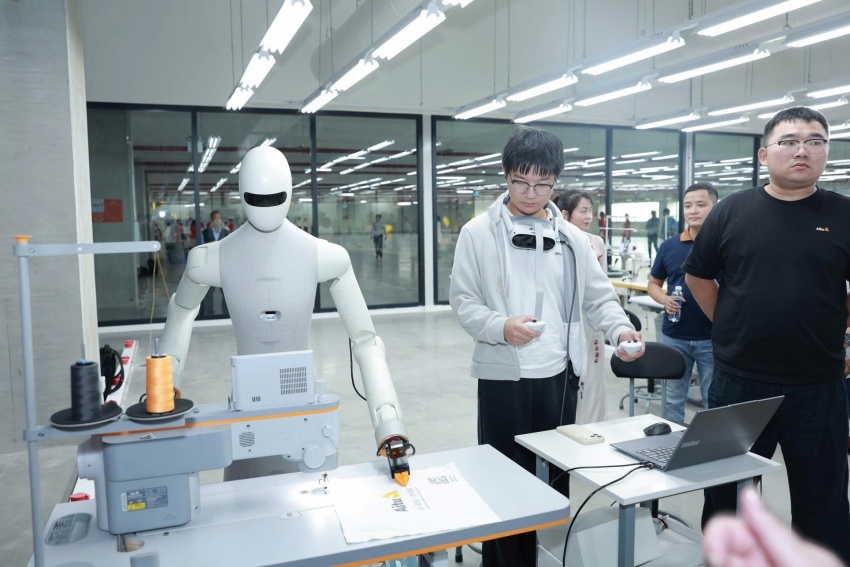
An AI-powered robot in operation at Spectre’s new factory in Hung Yen province. Photo: Spectre
The company inaugurated its fourth factory in Vietnam on October 30 in the northern province of Hung Yen, with an investment of $30 million, including machinery and technology. The LEED Gold-certified facility is expected to avoid approximately 1,600 tonnes of CO₂ emissions annually compared with conventional factories of a similar size, while creating 3,000 local jobs.
The new facility, Spectre’s largest and most technologically advanced factory in Vietnam, marks another milestone in the company’s expansion strategy, bringing its total investment in the country to more than $60 million.
Designed with energy efficiency and environmental responsibility at its core, the factory incorporates solar energy, modern production technologies, and resource-saving solutions to minimise its environmental footprint.
Jesper Klausen, co-owner and chief business development officer at Spectre, said the investment reflected the company’s confidence in Vietnam as a long-term manufacturing base.
“Spectre is very proud of our latest investment project in Hung Yen, Vietnam. We are pleased to contribute to the local community by establishing a factory that sets new standards for the working environment while respecting and caring for the surrounding natural environment,” Klausen said.
“The project also includes new investments in automation and AI solutions that will represent the new standard for our factories.”
Speaking to VIR on the sidelines of the inauguration, Klausen emphasised that Vietnam had become an integral part of Spectre’s global production and supply chain.
The company’s entire manufacturing operations are now located in Vietnam, where it has steadily expanded its production footprint since establishing its first facility in 2010.
According to Klausen, the company is committed to adopting the highest possible standards in its manufacturing operations, particularly in energy efficiency, resource conservation, and environmental protection.
Beyond its LEED Gold certification, the new facility uses clean energy and incorporates rainwater harvesting systems to reduce water consumption. Rainwater collected from the surrounding area is reused for various purposes, including toilet flushing, helping conserve freshwater resources.
Klausen said Spectre also hoped its investment would encourage greater demand for green solutions and improve access to renewable energy in the local manufacturing ecosystem.
The company’s environmental ambitions extend beyond its newest factory. Spectre has set targets to reduce emissions from its own operations by 42 per cent and emissions across its value chain by 25 per cent by 2030.
To achieve these goals, the manufacturer is investing in cutting technologies, more efficient material utilisation, and waste treatment solutions to minimise production waste and improve resource efficiency.
Vu Duc Giang, chairman of the Vietnam Textile and Apparel Association, highlighted the significance of the project in supporting the industry’s transition towards greener and more sustainable manufacturing.
“The Spectre Hung Yen factory is expected to become a bright spot in Vietnam’s garment and textile industry, contributing to the greening of this multibillion-dollar industry and helping Vietnam maintain its competitiveness on the global textile and apparel map,” Giang said.
Alongside green investment, Spectre is accelerating the adoption of automation, AI, and digital management systems to improve operational efficiency.
The company recently implemented a new enterprise resource planning system across the group, integrating management processes and supporting more efficient production operations.
Automation is also being introduced across multiple stages of manufacturing, particularly in warehousing and transportation, supported by integrated IT systems.
Klausen said digitalisation and automation were increasing demand for technically skilled workers, making workforce development an essential part of the company’s long-term investment strategy.
Spectre currently employs more than 5,500 people across its four factories in Ninh Binh, An Giang, and Hung Yen.
The company has established Spectre Academy, an internal training centre providing professional development programmes for new employees and management personnel.
Klausen highlighted the capabilities of Vietnam’s workforce, noting that all management positions, including engineering and office functions, are held by Vietnamese employees.
He also identified the quality and dedication of local workers, alongside strong cooperation with authorities and communities, as key factors behind Spectre’s continued investment.
The company is also seeking to strengthen domestic sourcing where Vietnamese suppliers can meet its stringent material and quality requirements.
According to Klausen, sourcing locally offers advantages in transportation, delivery times, and environmental impact, supporting both operational efficiency and sustainability.
Spectre currently supplies international outdoor and sportswear brands, with products exported to more than 50 countries worldwide.
Speaking at the inauguration, Danish Ambassador to Vietnam Lina Gandløse Hansen described Spectre’s expansion as an example of how foreign investment can support industrial development while advancing environmental objectives.
“I am delighted to see Spectre continue to invest in Vietnam. This project shows how Danish-Vietnamese cooperation can support industrial growth while reducing emissions,” Hansen said.
“By combining modern technology, energy efficiency and local job creation, Spectre is a good example of how Danish investment can deliver economic opportunities while contributing to Vietnam’s green transition.”
The investment comes as Denmark and Vietnam deepen their economic partnership, following the elevation of bilateral relations to a Comprehensive Strategic Partnership in October 2026.
Denmark’s investment in Vietnam quadrupled between 2021 and 2025, exceeding $2.4 billion, making it the third-largest European investor in the country on a per-person basis.
For Spectre, the Hung Yen facility demonstrates how expanding manufacturing capacity can go hand in hand with reducing environmental impacts, investing in advanced technologies, and developing a skilled local workforce.
With its ambitious emissions reduction targets and continued investment in sustainable production, the company aims to strengthen Vietnam’s position in its global supply chain while contributing to the country’s green transition.
