
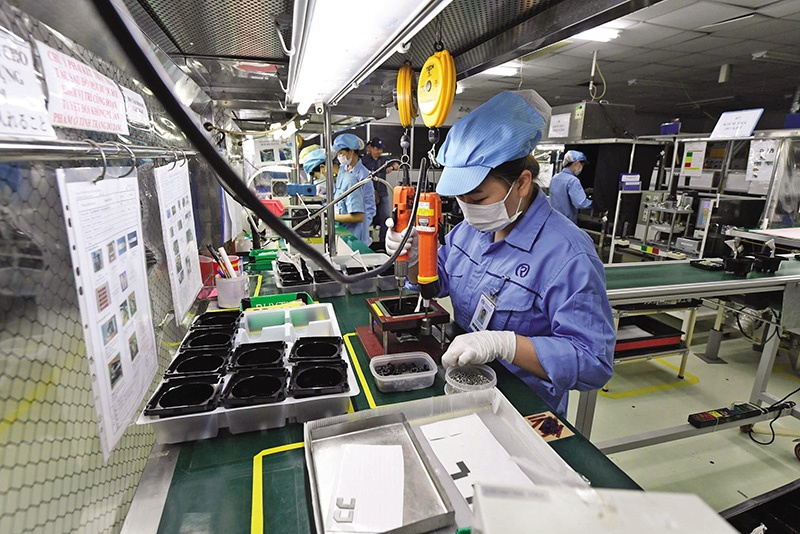
Photo: Duc Thanh
According to Dragon Capital, July offered a test the market rarely sets this cleanly: some of the strongest production data in years against the index’s sharpest monthly fall since March. The question, whether the first half’s growth composition could hold its momentum, was answered clearly. Capacity formation accelerated through every channel, and inflation fell month-on-month for a second consecutive month, confirming May as the peak.
Manufacturing gave the clearest reading. the index of industrial production (IIP) rose 14.5 per cent on-year in July and 11.4 per cent in seven months of this year, the strongest seven-month run in years, with breadth holding across metals, motor vehicles and electronics.
The Purchasing Managers’ Index (PMI) climbed to a five-month high of 52.9, corroborating the official series. The more telling number is manufacturing employment, up 3.3 per cent on-year. Firms are adding people and plant, not just running existing capacity harder.
Capital deployment tells the same story from two directions. Public investment disbursement rose 25.9 per cent on-year in July, taking seven months of this year to 39 per cent of the annual plan, with the usual year-end acceleration still ahead. Realised FDI of $15.2 billion was the strongest seven-month total in five years, up 11.8 per cent and 82.6 per cent directed to manufacturing, while registered FDI rose 58 per cent to $38.1 billion. Domestic and foreign capital are being committed to the production base simultaneously, and at scale.
Imports are where that build shows up first. Import growth of 34.8 per cent on-year in seven months of this year ran well ahead of exports at 21.7 per cent, swinging the trade balance from a $10.4 billion surplus a year earlier to a $20.5 billion deficit.
The composition defuses most of the alarm: 94.1 per cent of imports were production inputs, led by electronics and computer components, up 65.9 per cent to $135.8bn. This is the investment cycle in transit rather than consumption outrunning income, though the import build will need to convert into exports for the external accounts to rebalance.
Retail sales, up 13.1 per cent in seven months of this year and 7.5 per cent in real terms, remain steady support rather than the swing factor.
Inflation was the month’s most important quiet release. CPI fell 0.1 per cent on-month, a second consecutive decline that has taken more than a point off May’s 5.6 per cent on-year peak, and the seven months’ average of 4.4 per cent sits below the government’s 4.5–5 per cent ceiling.
Core inflation at 4.6 per cent and utility costs still warrant monitoring, but the direction has turned: policy room that looked compressed in May is reopening just as the investment cycle asks more of it.
Dragon Capital also notes that the index spent July trading the world rather than Vietnam. The VN-Index fell 6.3 per cent in USD terms to close at 1,735.8, with the damage concentrated in the week to July 24, a 5.7 per cent drop on Middle East risk, oil and US trade-policy headlines. The recovery was quick, with the index reclaiming 1,700 by July 29, though foreign investors net sold roughly $430 milllion on the Ho Chi Minh Stock Exchange and breadth stayed uneven.
The second half therefore starts constructive but more selective. FTSE implementation in September, lighter foreign positioning after months of net selling and reopening policy room all point towards a more positive outlook for the index in the coming months.
Domestic fundamentals hold firm as markets reprice global risk
Domestic fundamentals remain solid as markets reassess global risk, with Middle East tensions causing volatility.
First-quarter growth hits record high despite global volatility
Vietnam’s economy delivered a standout performance in the first quarter of 2026, with GDP expanding 7.8 per cent on-year – the strongest first-quarter growth on record.
Key factors to watch in the stock market in early 2026
A rebound in manufacturing, stronger domestic demand, record tourism and steady investment flows are laying a solid foundation for earnings momentum and improved market sentiment.
