
Rising labour costs, tightening quality requirements from global buyers, and increasing pressure to operate more sustainably are converging on factory floors across the country. What once worked, adding more shifts, more workers, more manual checkpoints, now creates new obstructions instead of solving them. In 2026, manufacturers and policymakers alike face a decisive moment: whether to treat automation as a series of isolated upgrades or as a structural pillar of the next industrial phase.
This is why the discussion around factory automation has shifted. It is no longer about future readiness. It is about present competitiveness.
Accelerating automation
Vietnam’s industrial momentum remains strong, but the nature of growth is changing. Manufacturing continues to attract the majority of foreign direct investment (FDI), with capital increasingly flowing into technology‑intensive and higher‑value production rather than purely labour‑driven assembly.
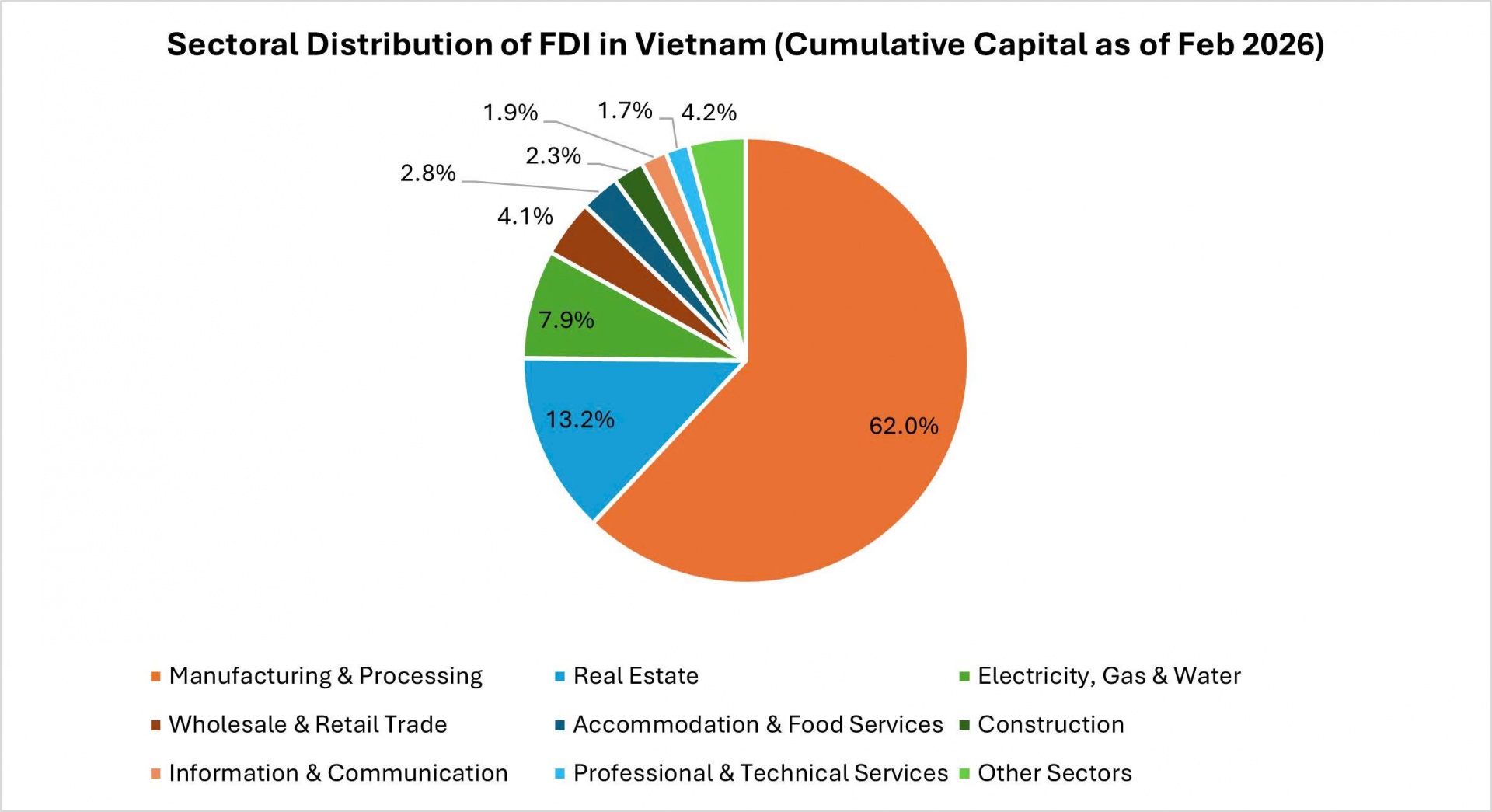
The cumulative registered FDI capital to Vietnam amounts to $533.4 billion, with 62 per cent directed toward manufacturing and processing, an unmistakable signal of investor expectations around productivity, reliability, and quality.
Figure 1. Manufacturing at the core: sectoral distribution of FDI in Vietnam (cumulative capital as of Feb 2026). Source: GSO Vietnam
At the same time, the cost structure that once underpinned Vietnam’s manufacturing advantage is shifting. Wage growth in industrial regions, combined with persistent skills shortages, is reducing the effectiveness of labour‑intensive expansion. For many manufacturers, automation is no longer framed as a capital‑heavy ambition, but as a strategic response to stabilise output, reduce error rates, and protect margins over the long term.
This acceleration is also linked to Vietnam’s role in global supply chain diversification. As international manufacturers pursue “China+1” strategies, Vietnam is no longer competing solely on cost. It is increasingly assessed by its ability to deliver consistent quality at scale, supported by modern production systems.
Higher quality standards and global supply chain demands
Electronics and electrical manufacturing lead the shift, as manufacturers face strict demands on precision, traceability, and defect prevention. Automation here typically starts with sensing, inspection, and data capture, where manual processes struggle to meet zero‑defect expectations.
In automotive and industrial components, requirements go beyond product quality to include process documentation and repeatability. Tier‑one and tier‑two suppliers must demonstrate stable, auditable production, increasing demand for precise motion systems, reliable controls, and integrated quality monitoring.
Food and beverage processing follows a similar logic from a different angle. Hygiene, consistency, and export compliance are pushing manufacturers towards automated handling, filling, and monitoring to reduce contamination risks and improve batch reproducibility.
In parallel, textiles and garments are increasingly part of the automation discussion. Rising wage pressure, stricter sustainability requirements, tighter delivery schedules, and higher expectations from international buyers are accelerating selective automation in areas such as material handling, cutting, quality inspection, and internal logistics, supporting greater consistency, resource efficiency, and traceability.
Finally, logistics and intra logistics are critical enablers. Export‑oriented manufacturing depends on warehouses and material flows that keep pace with more automated and time‑sensitive production, making smart storage, automated retrieval, and connected logistics an integral part of automation strategies.
The pressure is consistent: global buyers increasingly no longer accept variability as the cost of doing business in emerging markets.
Figure 2. Vietnam’s export structure: manufacturing and technology lead in 2025 ($ billion). Source: GSO Vietnam
Government policy and industrial strategy
Vietnam’s policy framework has increasingly reinforced this shift. Industrial development is now closely linked to productivity, sustainability, and regulatory clarity rather than sheer output volume. The broader reform agenda emphasises the transition towards a knowledge‑based, digital, green, and circular economy, with manufacturing at its core.
Instead of prescribing specific technologies, policy signals focus on outcomes such as higher efficiency, stronger compliance with international standards, and long‑term competitiveness. This approach favours manufacturers that invest in robust systems and clear planning horizons, and creates a more predictable environment for foreign investors. Continued alignment with international trade frameworks, including the EVFTA, reinforces expectations around quality, transparency, and technical standards across industrial value chains.
Towards sustainability and smart factories
By the end of 2026, automation will no longer be judged only by output per hour, but increasingly by resource efficiency. Smart factories combine production control with energy management, space optimisation, and waste reduction, using sensors and digital systems to expose inefficiencies that were previously hidden.
This shift aligns with Vietnam’s sustainability ambitions and long‑term net‑zero goals. For manufacturers, competitiveness now depends on automation that delivers efficiency beyond labour replacement and supports growing environmental expectations.
German expertise: enabling systems, not just machines
As Vietnamese manufacturers move from pilot automation to system‑wide upgrades, the challenge is no longer access to technology, but effective integration. Automation success increasingly depends on how data, motion, material flow, and control systems function together as a reliable whole. This is where German expertise comes into play, through interoperable building blocks designed for long‑term performance.
Smart sensing and measurement technologies support data‑driven production and predictive maintenance, as seen in Baumer’s work. Integration software from EVO Informationssysteme connects machines and value chains, helping scale automation beyond isolated applications. Modular solutions combining pneumatic, electric, and digital technologies, represented by Festo, enable gradual factory expansion without rigid layouts.
Precision remains essential. Motion and positioning systems associated with FIBRO ensure accuracy and repeatability, while smart intra logistics and storage solutions from Hänel improve throughput and space efficiency. Advanced manufacturing technologies from TRUMPF support higher‑value production, and reliable connectivity solutions from WAGO ensure consistent system performance.
Together, these capabilities reflect a German approach to automation that emphasises interoperable systems, lifecycle reliability, and standards‑driven design. As many Vietnamese manufacturers continue to strengthen internal engineering capacity, this focus aligns closely with the country’s transition towards quality, sustainability, and resilient growth.
Where dialogue meets practice
As 2026 unfolds, the central question for Vietnam’s manufacturing sector is not whether automation will continue, but whether it will be implemented strategically.
Platforms that bring together manufacturers, technology providers, and policymakers play a critical role in this process. The “Factory Automation Symposium – Made in Germany 2.0,” organised by AHK Vietnam, is one such forum. It offers Vietnamese industry stakeholders the opportunity to explore practical automation approaches, exchange experience, and engage directly with German expertise focused on real‑world applications rather than abstract concepts.
Figure 3. Factory Automation Symposium – Made in Germany 2.0. Source: AHK Vietnam
In a year defined by decisions rather than experimentation, such dialogue matters. Vietnam’s path towards smart factories will not be shaped by technology alone, but by how thoughtfully it is integrated into people, processes, and long‑term industrial strategy.
The choice in 2026 is clear: build smart capability now, or risk falling behind as global manufacturing moves on.
German expertise meets Vietnamese ambition
Not long ago, Vietnam was best known for low-cost manufacturing. Today, it is emerging as a strategic player in global supply chains, and a key partner for German industry.
German firm unveils $175 million R&D centre plans in Ho Chi Minh City
Germany’s SAP, the world’s largest provider of enterprise application software, on August 7 announced plans to invest more than €150 million (around $175 million) over the next five years into SAP Labs Vietnam, a new research and development (R&D) centre in Ho Chi Minh City.
Germany and Vietnam discuss development cooperation
Germany has pledged €185.5 million ($215.2 million) to Vietnam for development projects over the next two years, according to a statement from the Embassy of the Federal Republic of Germany.
